
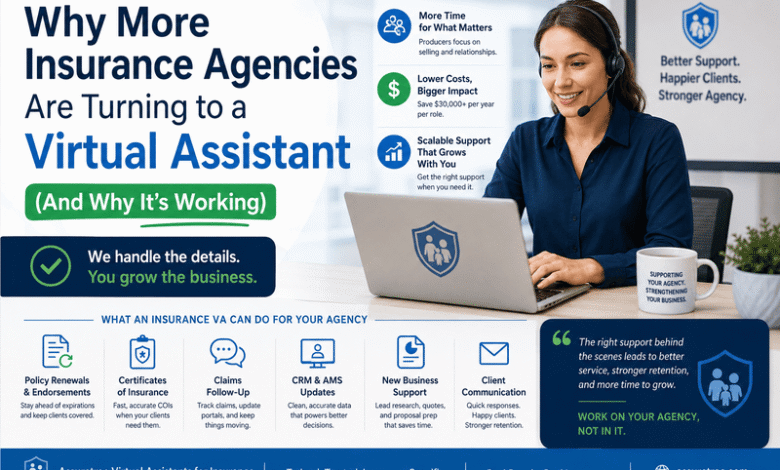
If you own or manage an insurance agency, you already know the drill. You started this to help clients, build relationships, and grow a business. But somewhere between the policy renewals, the certificate requests, the carrier portal updates, and the endless data entry, the actual work of running an agency starts to feel like it’s running you.
That’s not a productivity problem. That’s a structural problem. And a virtual assistant for insurance is how a growing number of agencies are fixing it.
Too Much Admin, Not Enough Selling
Here’s something most agency owners quietly admit: their best producers are spending hours every week on tasks that don’t require a producer’s skill set. Chasing renewals. Updating CRM records. Generating auto ID cards. Processing endorsements. These are important tasks — but they don’t need your most experienced people doing them.
When producers are buried in paperwork, they’re not on calls with prospects. They’re not nurturing relationships with existing clients. They’re not closing the business. And that gap between what they should be doing and what they’re actually doing? That’s lost revenue—every single week.
A trained virtual assistant for insurance — from Assuretrac — steps into that gap. They take the administrative load off your team so your producers can get back to doing what they were hired to do.
What an Insurance VA Actually Does (Day to Day)
This is where many agencies get confused. They think “virtual assistant” means someone who answers emails or books calendar appointments. That’s not what we’re talking about here.
An insurance-specific VA is trained on the actual workflows your agency runs on. They know how to navigate carrier portals. They understand ACORD forms. They can work inside Applied Epic, AMS360, HawkSoft, or EZLynx — whichever platform your agency uses. They handle things like:
Policy renewals and endorsements
Your VA tracks upcoming renewals, processes endorsement requests, and makes sure nothing slips through the cracks during your busiest seasons.
Certificates of Insurance (COIs)
One of the highest-volume, most time-sensitive tasks in any agency. A VA handles these fast, so your clients aren’t left waiting.
Claims follow-up
Staying on top of open claims is exhausting. Your VA tracks progress, enters data into carrier portals, and keeps communication moving with adjusters, so your team always knows where things stand.
CRM and AMS updates
Dirty data is one of the biggest silent killers of agency efficiency. Your VA keeps records clean, current, and consistent — so when you pull a report or look up a client, the information is actually accurate.
New business support
Collecting lead data, preparing quotes, and organizing proposals. Your producers walk into client conversations prepared, not scrambling.
Client communication
Routine inquiries, policy change requests, coverage questions. Your clients get fast responses, which keeps them happy and less likely to shop around.
The Cost Conversation (Let’s Be Honest About It)
Hiring in-house staff is expensive. By the time you add salary, benefits, payroll taxes, office space, equipment, and the time it takes to recruit and train someone, you’re often looking at well over $60,000 a year for a single support role. For a small or independent agency, that’s a serious commitment.
Virtual assistants work differently. You pay for the support you actually need, without any of the overhead. Agencies that make the switch typically save $30,000 or more per year per role — money that can go back into hiring producers, investing in technology, or simply improving your margins.
And unlike a full-time hire, a VA scales with your business. Need more hours during renewal season? Done. Quieter period? Dial it back. You’re never paying for capacity you don’t need.
They’re Not Chatbots. They’re Real People.
This is worth saying clearly, because there’s a lot of confusion in this space right now.
An insurance virtual assistant is a human professional — not an AI tool, not a chatbot, not an automated system. They think. They adapt. They understand context. When a situation doesn’t fit neatly into a checklist, they exercise judgment. That’s something no automation can replicate, especially in an industry as nuanced and compliance-sensitive as insurance.
The best providers — like Assuretrac — train their assistants specifically on insurance workflows before they ever work with a client agency. There’s no three-month learning curve where your VA is figuring out what a mortgagee change is. They come in already knowing the work.
When Your Clients Start Noticing the Difference
Client retention in insurance often comes down to one thing: responsiveness. When a client emails asking for an updated ID card and gets it within the hour, they feel taken care of. When they wait two days, they start wondering if they should look elsewhere.
This isn’t about doing extraordinary things. It’s about consistently doing the ordinary things fast and right. A VA focused on client service tasks makes that level of responsiveness possible — even when your internal team is swamped.
Agencies that implement a virtual assistant for insurance often notice the change in client feedback before they notice it in their numbers. Fewer complaints. Faster turnarounds. Higher satisfaction. The numbers catch up soon after.
How to Know If You’re Ready for a VA
You don’t need to be a large agency to benefit from this. In fact, small and mid-sized agencies often see the biggest impact because the time savings and cost reduction are felt most directly.
Ask yourself honestly: Are your producers regularly doing work that doesn’t require their license or expertise? Are client response times slower than you’d want them to be? Do your renewal seasons feel chaotic every single year? Are you hesitant to take on new business because you’re not sure your team can handle the volume?
If any of those hit close to home, it’s worth taking a serious look at what a virtual assistant could do for your operation. This isn’t about replacing your team. It’s about giving them the support they need to actually perform at their best.
What to Look for When You Hire
Not every VA provider understands insurance. A general VA might be great at calendar management or social media — but they’ll struggle with carrier portals, compliance documentation, and policy servicing workflows. Insurance has its own language, and you need someone who already speaks it.
When you’re evaluating options, look for providers who can demonstrate real insurance experience, not just administrative experience. Ask about the specific platforms and workflows their VAs have worked with. Ask how they handle data security — you’re dealing with clients’ personal and financial information, and that cannot be treated lightly.
Assuretrac was built specifically for insurance agencies in the U.S. Their assistants aren’t generalists who’ve been given a basic overview — they’re trained deeply on insurance-specific workflows, compliance requirements, and the tools your agency already uses. Onboarding is fast, and the learning curve is short because the groundwork is already done.
Frequently Asked Questions
Q1: Is an insurance virtual assistant a real person or some kind of automation?
A real person. An insurance VA is a trained human professional who works remotely. They think independently, adapt to your specific workflows, and handle complex tasks that require genuine judgment — not scripted responses. Think of them as a remote team member, not a software tool.
Q2: My agency uses Applied Epic and AMS360. Will a VA actually know how to use those?
A good insurance-specific VA absolutely should. Providers like Assuretrac train their assistants on industry-standard platforms before placing them with client agencies. If a provider can’t confirm platform-specific experience upfront, that’s a red flag worth taking seriously.
Q3: How much does it actually cost compared to hiring in-house?
The savings are significant. When you account for salary, benefits, taxes, recruitment, office space, and equipment, an in-house hire can cost $60,000–$70,000 or more per year. Virtual assistant arrangements eliminate most of that overhead, with many agencies saving $30,000 or more annually per role — without any reduction in the quality of work.
Q4: How long does it take for a new VA to get up to speed with how my agency works?
Much faster than a traditional hire, especially with a specialized provider. Because Assuretrac’s assistants already understand insurance workflows and platforms when they start, most are contributing meaningfully within the first few days. The onboarding time is a fraction of what you’d experience with a new in-house employee.
Q5: We’re a small independent agency. Is this really something that makes sense for us?
Honestly, small agencies often benefit the most. The administrative burden relative to team size is usually higher, and the cost savings hit the bottom line more directly. If your current setup has your producers doing work that doesn’t require their expertise, a virtual assistant is one of the most practical changes you can make — regardless of how big or small your operation is.
Check out these additional resources to sharpen your expertise.