
Just weeks ago, the United Arab Emirates stood at the center of global capital flows, attracting investors, institutions, and talent from every direction.
Cities like Dubai and Abu Dhabi were increasingly compared to established financial hubs such as London, offering a mix of stability, opportunity, and global connectivity. But the rapid escalation of tensions between Iran, Israel, and the United States has begun to shift that narrative.
The Emirates Dream: What Made It Work
The rise of the United Arab Emirates was not accidental. It was the result of a carefully built model that combined stability, openness, and global integration at a time when many regions were moving in the opposite direction. Dubai and Abu Dhabi positioned themselves not just as regional hubs, but as global gateways where capital, talent, and business could move freely.
At the core of this success was a clear strategy. The UAE offered a low-tax environment, business-friendly regulations, and modern financial centers such as DIFC and ADGM, which attracted banks, hedge funds, and international firms. Its geographic position created a natural bridge between Asia and Europe, turning the country into a key hub for aviation, trade, and logistics.
Beyond economics, perception played a major role. The UAE built a reputation for safety, political neutrality, and high living standards. Clean cities, strong infrastructure, and a highly international workforce made it especially attractive for expatriates and investors looking for both opportunity and stability.
Unlike many resource-driven economies, the UAE diversified early. Finance, tourism, real estate, aviation, and technology became key growth engines. This diversification created resilience, but it also tied the system closely to global confidence. The Emirates dream worked because everything was connected, and as long as stability remained intact, the model kept expanding.
The Most Developed Sectors in the UAE
The UAE’s growth story is built on a diversified economic structure, where multiple sectors developed in parallel and reinforced each other. This interconnected system is what turned the country into a global hub within a relatively short time.
Finance and Capital Markets
Finance sits at the center of the UAE model. Dubai and Abu Dhabi have positioned themselves as regional financial capitals, competing with global hubs like London and Singapore. Free zones such as DIFC and ADGM offer internationally aligned legal frameworks, attracting banks, asset managers, hedge funds, and family offices.
One of the fastest-growing segments within this ecosystem is forex brokerage in the UAE. The region has become a key base for brokers targeting global clients, particularly from Asia, MENA, and emerging markets. Competitive regulation, access to liquidity providers, and advanced infrastructure have supported this growth. Combined with rising demand for leveraged trading products, the UAE has evolved into a strategic hub for brokerage operations, IB networks, and institutional partnerships.
At the same time, Dubai has become one of the leading global hubs for physical gold trading. Through institutions like the Dubai Multi Commodities Centre (DMCC), the city facilitates large volumes of gold refining, storage, and re-export, connecting supply chains from Africa, Asia, and beyond. This physical gold ecosystem supports liquidity, trade finance, and wealth preservation flows, further strengthening the UAE’s role in global commodity markets.
Real Estate and Construction
Real estate has been one of the most visible growth drivers, fueled by foreign investment, residency incentives, and demand for luxury properties. Large-scale developments and high-end projects have positioned cities like Dubai as global property hotspots.
Tourism and Hospitality
Tourism remains a key pillar, supported by world-class infrastructure, events, and luxury experiences. The UAE consistently attracts millions of visitors each year, making it one of the most competitive destinations globally.
Aviation and Logistics
The country’s strategic location has turned it into a global transit hub. Airlines like Emirates and major ports connect continents, supporting both passenger traffic and global trade flows.
Technology and Data Infrastructure
The UAE has invested heavily in digital infrastructure, attracting global tech firms and cloud providers. Regional hubs for companies like Amazon (AWS) and Microsoft have strengthened its position as a growing technology center.
What Has Changed: War Reaches Economic Infrastructure
The key shift is not just the existence of conflict, but its proximity to critical economic systems. What was once seen as a distant geopolitical issue is now directly tied to infrastructure that supports global trade and energy flows.
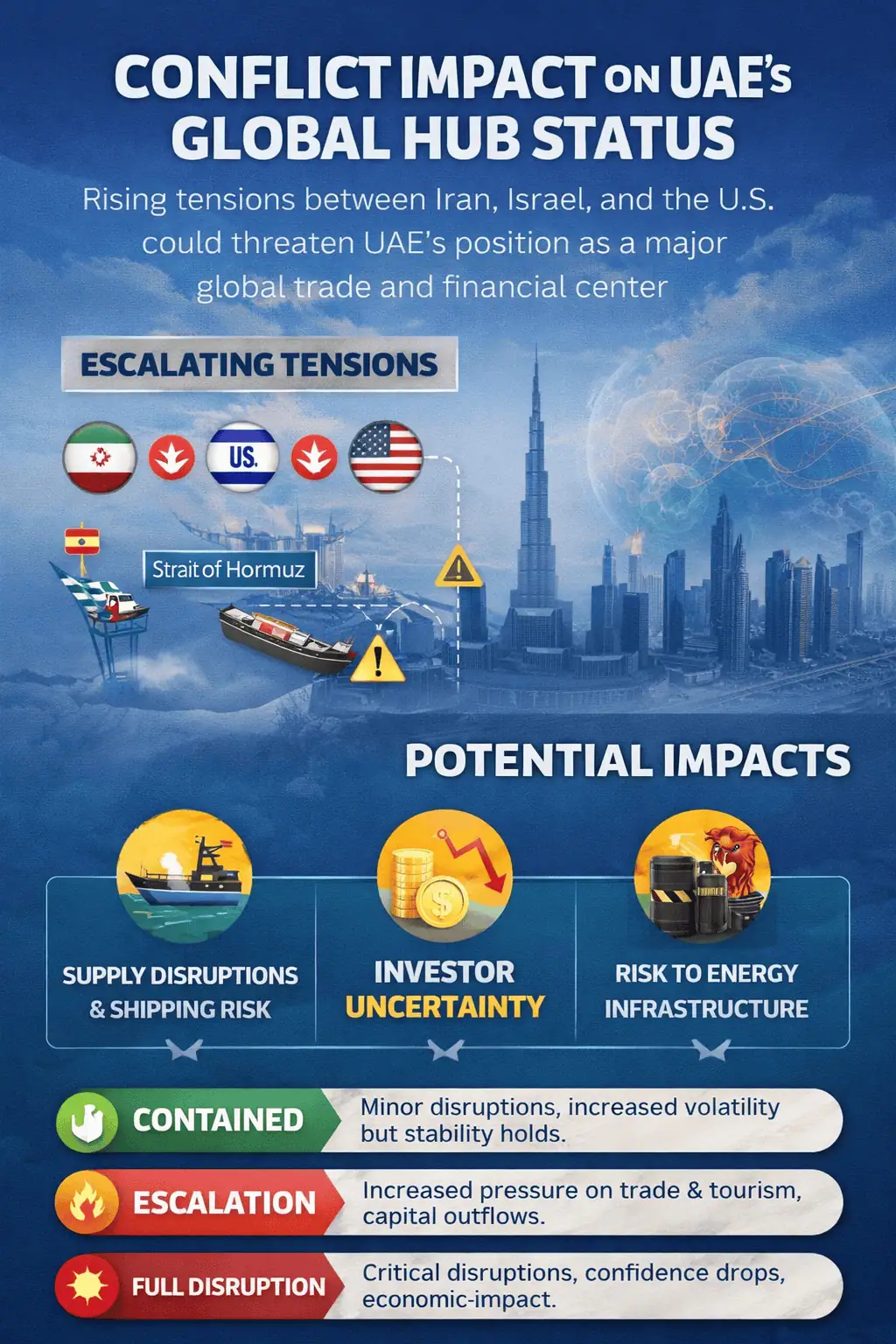
Rising tensions around strategic routes like the Strait of Hormuz have increased concerns over supply disruptions, insurance costs, and shipping security. Even without full-scale damage, the mere risk is enough to impact pricing, logistics, and investor sentiment.
At the same time, the scope of potential targets has widened. Energy facilities, airports, logistics hubs, and even digital infrastructure are now part of the broader risk landscape.
For economies like the UAE, which rely heavily on uninterrupted connectivity and global confidence, this creates a new layer of uncertainty. The system itself remains intact, but the perception of stability, which has always been its strongest asset, is starting to be tested.
The Fragility Behind the Model
The UAE’s strength comes from efficiency and global integration, but that same structure also creates hidden vulnerabilities. The country relies heavily on imports for food, water, and basic resources, with limited agricultural capacity and natural freshwater supply.
Its workforce is largely international, and its economic activity depends on continuous inflows of capital, talent, and business activity from abroad.
What makes the model particularly sensitive is its dependence on perception. Stability, safety, and predictability are not just advantages, they are the foundation of the entire ecosystem. Real estate demand, financial inflows, tourism, and even long-term residency decisions are all tied to that perception. If the region starts to be seen as a higher-risk environment, even temporarily, the reaction can be swift. Capital does not wait.
The Safe Haven Narrative
For years, the UAE has been positioned as a neutral, stable destination in a region often associated with volatility. This perception helped attract global capital, especially during periods of uncertainty elsewhere. Investors, entrepreneurs, and institutions viewed Dubai and Abu Dhabi as their safe heavens.
But this status is not eternal, it is built on confidence. As tensions move closer to the Gulf, that narrative begins to soften. Even without direct impact, rising regional risk can lead to higher premiums, more cautious investment decisions, and slower capital inflows. The shift is often gradual at first, but once perception changes, markets tend to adjust quickly.
Scenario Analysis: What Happens Next
The path forward depends on how far the conflict spreads and whether key economic routes and infrastructure remain intact. Markets will react not only to actual damage, but to expectations around risk and stability.
Scenario 1: Contained Conflict
Tensions remain elevated but geographically limited, with no direct impact on major Gulf infrastructure. The UAE continues to operate normally, although with increased volatility and cautious capital flows. Investor confidence weakens slightly, but the overall model holds, supported by strong reserves and policy flexibility.
Scenario 2: Regional Escalation
The conflict expands across the region, increasing pressure on energy routes, logistics, and investor sentiment. Tourism and real estate activity begin to slow, while risk premiums rise across financial markets. Capital inflows weaken, and some short-term outflows may emerge as global investors reduce exposure to the region.
Scenario 3: Full Disruption of Gulf Stability
Critical infrastructure and key routes such as the Strait of Hormuz face serious disruption, triggering a sharp rise in oil prices and global market stress. Under this scenario, the UAE’s core advantages, stability, connectivity, and safety perception, come under direct pressure. Capital flight accelerates, economic activity slows significantly, and the resilience of the entire model is tested.
Is This the End of Dubai and Abu Dhabi?
It is unlikely that Dubai and Abu Dhabi will face an immediate collapse. These are not fragile or underdeveloped systems. They are highly advanced, well-capitalized cities with strong governance, deep financial reserves, and global connections.
Even under pressure, the UAE has tools to stabilize markets, support liquidity, and maintain operational continuity. In past periods of regional tension, the country has shown an ability to adapt quickly and protect its core economic structure.
However, this situation is different in one key aspect. The risk is not just physical disruption, but a gradual shift in perception. These cities have been built as symbols of stability in a volatile region. If that perception weakens, even slightly, the effects can spread across real estate, finance, tourism, and capital flows.
The question is no longer whether Dubai and Abu Dhabi can survive, but whether they can maintain the level of confidence that made them global hubs in the first place.