

If you ask someone outside the IT department what a business analyst does, you will probably get a very simple answer. Most people think we just schedule meetings, listen to what stakeholders want, and write those wishes down in a long document. They see us as translators who take business language and turn it into technical requirements for the development team.
Early in my career, I might have agreed with them. But after spending over a decade as a senior business analyst, I can tell you that this view is completely outdated. If a business analyst is only acting as an order taker, they are leaving a massive amount of value on the table.
Today, the real measure of our success is not how many user stories we write. The true measure of our success is business analyst ROI. We are strategic partners. Our main job is to make sure that the money a company spends on a project actually delivers a solid return on investment. Here is exactly how business analysts drive ROI and protect the bottom line.
Moving Beyond Simply Taking Notes
The biggest trap in the tech industry is the belief that the customer always knows exactly what they need. Often, a stakeholder will come to my desk and say they need a new custom software platform to track their team tasks. A junior analyst might immediately start writing down the features for this new platform. They will list out the login screens, the dashboard layouts, and the notification settings.
A senior analyst takes a completely different approach. Instead of asking how the system should work, we ask why the system is needed in the first place.
In my experience, digging into the “why” is the fastest way to save a company money. In that scenario, asking a few strategic questions might reveal that the team is just struggling to communicate. Instead of spending two hundred thousand dollars to build custom software, the solution might be to simply use the existing project management tools they already pay for.
By pushing back and finding the root cause of a problem, we prevent the company from wasting money on the wrong solutions. This is the foundation of project success.
Key Ways a Business Analyst Increases Return on Investment
It is easy to say we add value. It is much better to show exactly how we do it. When you look closely at a well run project, you can see the financial impact of a good business analyst in several different areas.
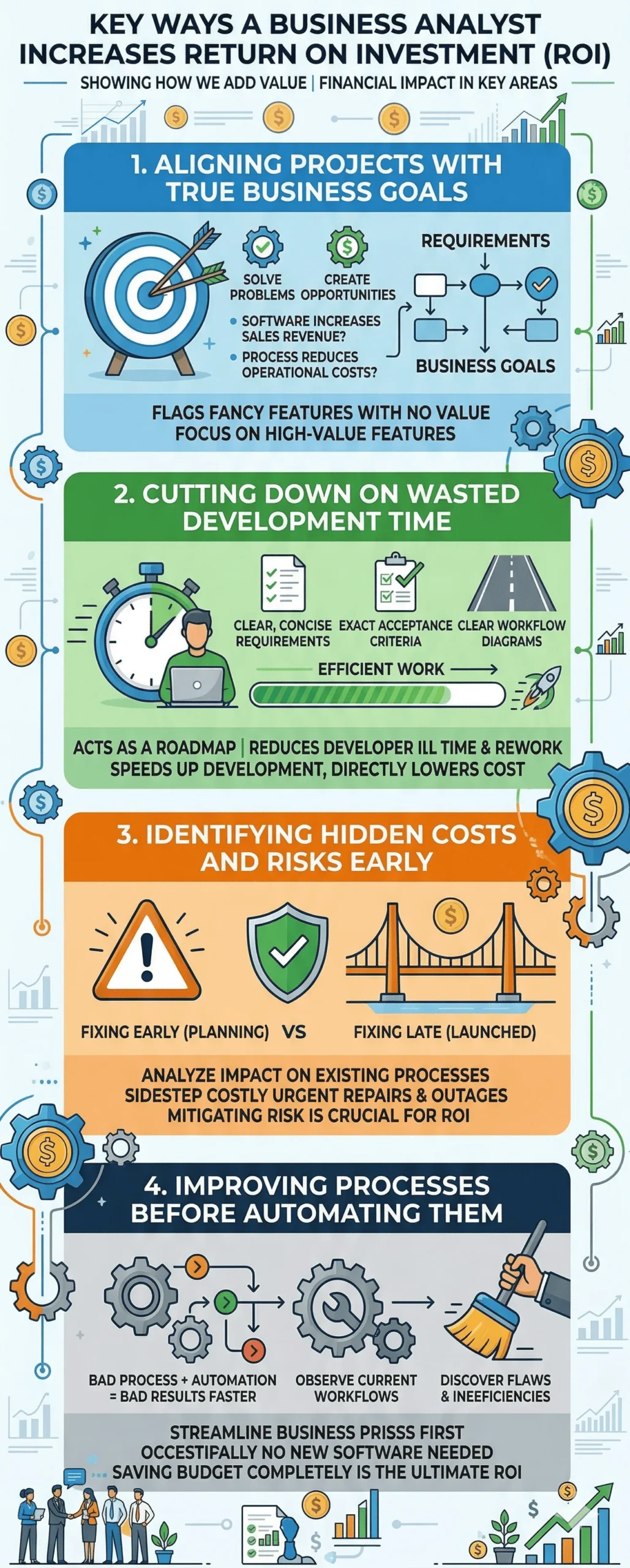
1. Aligning Projects with True Business Goals
Every project should exist to solve a problem or create a new opportunity. Will this software increase our sales revenue? Will this new process reduce our operational costs? If a project does not do one of these things, it is probably a waste of resources.
My job is to map every single requirement back to a specific business goal. If a stakeholder requests a fancy new feature that looks cool but does not help the company make money or save time, I flag it. By keeping the development team focused only on features that provide clear value, we maximize the return on the project budget.
2. Cutting Down on Wasted Development Time
Software developers are highly skilled and their time is very expensive. When developers are forced to sit idle because requirements are confusing, the company loses money. Even worse, if a developer builds a feature based on bad requirements, they will have to delete their work and start over. This rework is a massive drain on project budgets.
Clear, concise, and logical business requirements act as a roadmap for the tech team. When I provide developers with exact acceptance criteria and clear workflow diagrams, they can write code faster and with fewer errors. Reducing development time directly lowers the cost of the project. This is a very clear example of how business analysts drive ROI on a daily basis.
3. Identifying Hidden Costs and Risks Early
Fixing a mistake during the planning phase costs almost nothing. Fixing that same mistake after the software has launched can cost thousands or even millions of dollars.
A major part of my role involves looking for hidden risks. I spend a lot of time analyzing how a new system will affect existing processes. Will the new marketing tool break the current sales database? Does the new payment gateway align with our existing security protocols? Identifying any discrepancies upfront helps us sidestep costly, urgent repairs and system outages down the line. Mitigating risk is as crucial to our return on investment as bringing in revenue.
4. Improving Processes Before Automating Them
There is an old saying in the tech world. If you automate a bad process, you just get bad results faster.
Before we write a single line of code, I sit down with the people who actually do the work. I observe their screen navigation, their file storage habits, and their information-sharing practices. Frequently, I discover that the underlying processes are flawed. Employees might be unwittingly repeating tasks or inputting data manually when automation could be used.
Reducing waste starts with streamlining the business process itself. Occasionally, the improvements we make are so significant that we can forgo the need for new software altogether.
Saving a project budget completely by fixing a human process is the ultimate business analyst ROI.
Real World Example: Turning a Loss into a Win
A few years ago, I was assigned to a massive digital transformation project. The leadership team wanted to replace their old customer relationship management system. The initial budget was set at a million dollars. They had a vendor ready and were prepared to sign the contract.
I asked for two weeks to evaluate the current state of the sales team. I sat with the sales representatives and watched them work. I quickly realized that the old system was actually very powerful. The problem was that nobody had ever trained the sales team on how to use it properly. The data was messy, the workflows were ignored, and the staff was frustrated.
I presented my findings to the leadership team. I recommended that instead of spending a million dollars on new software, we spend fifty thousand dollars on a data cleanup initiative and a new training program. They agreed. Within three months, the sales team was working efficiently and our lead conversion rates went up by twenty percent. We saved the company nine hundred and fifty thousand dollars and still achieved the desired business outcome. That is the true value of stakeholder alignment and root cause analysis.
How to Build These High Level Skills
You do not learn how to challenge executives or redesign global processes overnight. It takes time, practice, and a willingness to step out of your comfort zone.
When you first start out in this career, you have to master the basics. You need to know how to write user stories, create process models, and manage stakeholder meetings. If you are new to the field or looking to transition into this career, building a strong foundation is critical. I always recommend finding structured learning paths. For instance, taking a comprehensive business analyst course can teach you the core techniques needed to succeed on day one.
However, as you move into senior roles, the expectations change. You need to understand enterprise architecture, financial modeling, and advanced strategy. You have to prove to senior management that you are a business partner, not just a technical writer. For experienced professionals looking to validate their strategic skills and command higher salaries, pursuing advanced credentials makes a big difference. Investing your time in formal Cbap training is one of the best ways to master the advanced concepts that truly drive business value.
Final Thoughts on the True Value of a BA
The role of the business analyst has evolved. The days of simply taking notes and passing them to developers are gone. Today, businesses are operating in highly competitive markets with very tight budgets. They cannot afford to build software that nobody uses. They cannot afford to solve the wrong problems.
When you understand how business analysts drive ROI, you stop looking at us as administrative overhead. We are the bridge between a business problem and a profitable solution. By asking the tough questions, aligning projects with financial goals, preventing development rework, and fixing broken processes, we ensure that every dollar spent on technology is a dollar well spent.
If you are a business analyst reading this, I encourage you to step up. Stop just gathering requirements. Start actively looking for ways to save money, increase revenue, and make the business better. That is how you build a lasting, impactful career.